
Awtar Krishna Kaul
Awtar Krishna Kaul was a film director who made the Hindi Film 27 Down (1974). It was his only film before he died in a tragic incident in 1974.
Awtar was born on September 27, 1939, in Srinagar, Jammu and Kashmir. His family later moved to Delhi. He initially worked for the Ministry of External Affairs, a job he held until 1964. In 1960, he was posted to the Indian Embassy in New York, where he decided to pursue a filmmaking course and met his American wife, Anne.
He returned to India in 1970 and joined Merchant Ivory Productions as an assistant director for their film Bombay Talkie. During this period, parallel cinema was emerging in India, and Kaul was encouraged by the National Film Development Corporation (NFDC) to make his debut film.
Awtar Krishna Kaul is primarily known for his sole feature film, 27 Down, released in 1974. He wrote, directed, and produced this film, which starred MK Raina and Rakhee. The movie, shot in black and white, depicted the life of a railway ticket collector and used the train as a metaphor for life’s journey. It was noted for its realistic portrayal of everyday Indian life and sensitive handling of a young couple’s relationship.
Tragically, Awtar Krishna Kaul died on July 20, 1974, in a drowning accident in Bombay, on the very day 27 Down was announced as the winner of two National Awards. He was 34 years old at the time of his death.
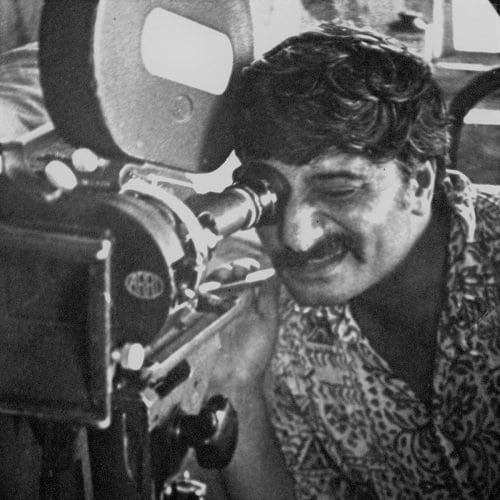
Life and Early Work
Awtar Krishna Kaul was born on 27 September 1939 in Srinagar, in the Kashmir Valley, into a Kashmiri Pandit family. His upbringing unfolded against the backdrop of a region of extraordinary cultural richness and, in the years following Partition, of acute political sensitivity. The family later relocated to Delhi, and it was from the capital that Kaul launched a career whose early trajectory bore little obvious relation to the cinema he would eventually make.
Kaul first entered government service, joining the Ministry of External Affairs. His initial posting took him to Pakistan, and in 1960 he was assigned to the Indian mission in New York. It was this transatlantic relocation that proved decisive. Rather than pursue the steady advancement of a diplomatic career, Kaul resigned his position the same year in order to enrol in a diploma programme in filmmaking at the Institute of Film Techniques in New York, then associated with the City College of New York. The decision marked a profound reorientation of his life, exchanging the security of officialdom for the uncertain vocation of the artist.
He remained in the United States for some fourteen years, an unusually long and formative immersion in a foreign film culture. Between 1964 and 1968 he pursued a bachelor’s degree in filmmaking at the City University of New York. To support himself through his studies, he worked in a succession of jobs that kept him close to the worlds of language and information: he served as a copyholder — a copyeditor and typesetter’s assistant — for the Associated Press, and as an editor at the British Information Services in New York. During these American years he married Anne, an American, and absorbed the currents of post-war world cinema then transforming film practice on both sides of the Atlantic.
This long apprenticeship abroad distinguished Kaul from many of his Indian contemporaries, who were more typically trained at the Film and Television Institute of India in Pune. His exposure to American documentary technique, to the lightweight handheld aesthetics emerging in Europe and North America, and to the modernist literature of alienation that preoccupied mid-century intellectuals would all leave their imprint on his single film. He returned to India in 1970, equipped not with the apparatus of a studio but with a sensibility shaped by years of study, observation, and economic precariousness — the very condition that would furnish the emotional substance of his work.
Filmmaking
Kaul’s practical initiation into professional filmmaking came through his work as an assistant director on Bombay Talkie (1970), the Merchant Ivory production directed by James Ivory and written by Ruth Prawer Jhabvala. The association placed Kaul within one of the most cosmopolitan film enterprises operating in India at the time, an outfit that itself negotiated the space between Indian subject matter and an international art-cinema audience. The experience gave him direct exposure to a mode of production attentive to atmosphere, location, and the textures of contemporary Indian life, lessons he would shortly apply to a project entirely his own.
For his debut as a director, Kaul turned to literature. 27 Down was adapted from the Hindi novel Athara Sooraj Ke Paudhe by Ramesh Bakshi, a work whose preoccupation with the inner life of an ordinary man suited Kaul’s temperament precisely. He wrote the screenplay himself and also produced the film, assuming the financial as well as the creative risk. The picture was made on a modest budget of around eight lakh rupees, of which Kaul personally raised close to forty per cent; the remainder was furnished by the Film Finance Corporation, the state body — later reconstituted as the National Film Development Corporation — whose willingness to back uncommercial, director-driven projects underwrote the entire New Wave movement.
The narrative of 27 Down follows Sanjay, played by the actor and theatre director M.K. Raina, a young man who relinquishes his ambition to become an artist in order to honour his father’s wish that he take up the family profession of railway service. Working as a ticket inspector, Sanjay endures a life of routine and quiet resignation until he meets Shalini, a Life Insurance Corporation employee played by Raakhee, on a suburban train. Their tentative attachment briefly opens a horizon of possibility, but when Sanjay’s father learns of the relationship he arranges his son’s marriage to another woman, and Sanjay submits. The film unfolds in large part as a reverie, framed by a pilgrimage Sanjay undertakes aboard the 27 Down, the Bombay–Varanasi Express, his memories surfacing in flashback as the train carries him toward the sacred city of Varanasi.
The film’s achievement was inseparable from its collaborators. The cinematography was entrusted to Apurba Kishore Bir, then only twenty-two, who shot some seventy per cent of the film with a handheld camera and wide lenses, drawing inspiration from Gillo Pontecorvo’s The Battle of Algiers in his desire to place the camera within the very press and flux of life. Bir chose to work in black and white in order to exploit stark contrasts of light and shadow, and to render the railway’s steam, crowds, and machinery as an expressive landscape of the protagonist’s inner state. The platform sequences, difficult to control amid genuine crowds, were frequently shot at night or on side platforms. The production design was by Bansi Chandragupta, the celebrated art director closely associated with Satyajit Ray, and the editing by Ravi Patnaik. The score drew on the talents of classical musicians, including the flautist Hariprasad Chaurasia and the composer Bhubaneswar Mishra, whose contributions reinforced the film’s contemplative register. Much of the location work was carried out at Bhusaval railway junction and its steam yards, and at Mumbai’s Victoria Terminus and suburban lines.
Upon its completion in 1974, 27 Down was received with critical enthusiasm and swiftly garlanded with honours. At the 21st National Film Awards it won Best Feature Film in Hindi, while Bir’s camerawork earned the award for Best Cinematography. Abroad, the film secured the Ecumenical Prize at Locarno and a prize at the Mannheim International Film Festival. Yet the triumph was overshadowed by tragedy: in the same period that the national awards were announced, Kaul drowned off Walkeshwar in Mumbai while trying to rescue a friend who had slipped into the sea. 27 Down thus remained, irrevocably, his only film — a complete and self-contained statement rather than the first step of an unfolding career.
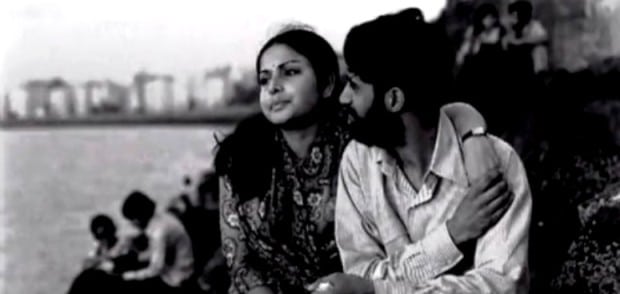
The Cinema of Awtar Krishna Kaul
To speak of the cinema of Awtar Krishna Kaul is, of necessity, to speak of a single film; and yet 27 Down is so fully realised that it sustains the weight of an authorial signature. Its sensibility is unmistakably modern, even modernist: it privileges interior experience over external incident, mood over melodrama, and ambiguity over resolution. Critics have repeatedly observed that the film brought to Hindi cinema a treatment of urban alienation comparable to that found in the European novel of the period — a recurring point of reference being Albert Camus — articulating a sense of estrangement and existential drift that mainstream Indian films had scarcely contemplated.
Formally, Kaul’s film exemplifies the New Wave’s reaction against studio artifice. The handheld camera, the location shooting amid real crowds and machinery, the unhurried rhythm and the elliptical, flashback-driven structure all serve to dissolve the boundary between the protagonist’s consciousness and the world he moves through. The railway is at once a literal setting and a sustained metaphor: the fixed track, the predetermined timetable, the ceaseless motion that nonetheless leads only where the rails permit, all mirror Sanjay’s entrapment within a life chosen for him by others. Kaul’s achievement lies in the integration of this metaphor into the very fabric of the image, so that meaning emerges from texture and movement rather than from dialogue or exposition.
Key Themes
Urban alienation and anonymity. Kaul’s film registers the loneliness and facelessness of life in the modern Indian city, where the individual is dwarfed by crowds, institutions, and the relentless machinery of routine. The railway, with its anonymous throngs, becomes the emblem of a society in which human connection is fleeting and easily lost.
Duty versus desire. At the heart of the narrative lies the conflict between personal aspiration and familial obligation. Sanjay’s surrender of his artistic ambitions, and later of his love, to the demands of his father dramatises the cost exacted by tradition and filial duty upon individual self-realisation.
Determinism and the loss of agency. The film is preoccupied with the psychological dislocation produced when one’s life is shaped by the decisions of others. Its imagery of fixed tracks and timetables expresses a quiet fatalism — an acceptance of destiny that is less serene resignation than muted defeat.
Interiority and memory. By organising its narrative around flashback and reverie, the film locates its drama within consciousness rather than action. The journey toward Varanasi functions as a frame for recollection, allowing the past to intrude upon and reinterpret the present.
The poetry of the everyday. Kaul and his cinematographer found visual lyricism in the ordinary materials of working life — steam, rails, platforms, the geometry of carriages — transforming the mundane infrastructure of the railways into a charged expressive landscape.
Selected Filmography
Bombay Talkie (1970). Kaul served as an assistant director on this Merchant Ivory production directed by James Ivory. Though not his own film, the experience constituted his apprenticeship in professional filmmaking and exposed him to a cosmopolitan, location-attentive mode of production that informed his subsequent work.
27 Down (1974). Kaul’s sole feature as director, screenwriter, and producer. Adapted from Ramesh Bakshi’s novel Athara Sooraj Ke Paudhe, it stars M.K. Raina and Raakhee in a meditation on duty, thwarted love, and urban alienation set against the Indian Railways. Winner of the National Film Award for Best Feature Film in Hindi and, for Apurba Kishore Bir, Best Cinematography, as well as the Ecumenical Prize at Locarno and a prize at Mannheim, it stands as one of the defining works of the Indian New Wave and is widely regarded as a classic of parallel cinema.
Legacy
The legacy of Awtar Krishna Kaul is uniquely concentrated and uniquely fragile, resting as it does upon a body of work consisting of a single film. That 27 Down continues to be discussed, screened, and celebrated more than half a century after its release is itself the measure of Kaul’s achievement. The film is routinely included among the essential works of the Indian New Wave, and it has been the subject of critical reappraisal in books and retrospectives — figuring, for example, in Avijit Ghosh’s survey of overlooked Hindi classics, where it is praised for bringing a Camus-like sensibility of alienation into Indian cinema for the first time.
Kaul’s film also served as a proving ground for collaborators who would go on to distinguished careers. The cinematographer Apurba Kishore Bir, barely out of his early twenties when he shot the film, established with it a reputation for bold, expressive camerawork and would become one of the most respected cinematographers and directors of Indian art cinema. The actor M.K. Raina, already prominent in theatre, found in Sanjay one of his most memorable screen roles. In this sense the film seeded talents whose subsequent work extended its influence well beyond Kaul’s lifetime.
More broadly, 27 Down stands as evidence of what the state-supported, director-driven cinema of the 1970s could achieve. Made with modest means and backed by the Film Finance Corporation, it vindicated the conviction that a serious, formally ambitious Indian cinema could be created outside the commercial mainstream. Its continued availability through national film archives and its periodic restoration and revival — including the celebration of its golden jubilee in 2024 — have ensured that it remains accessible to successive generations of viewers and scholars.
It is impossible to assess Kaul’s place in cinema history without confronting the question of what might have followed. His death at thirty-four, in an act of selfless courage, deprived Indian cinema of an artist who had announced himself with rare maturity and whose single film suggested a sensibility of unusual depth. The near-simultaneity of his greatest recognition and his death has lent his story a tragic resonance that, if anything, has sharpened critical attention to the work he left behind. Awtar Krishna Kaul endures, therefore, as both a fulfilled and an unfulfilled figure: the maker of one indelible film, and the embodiment of a promise that history was not permitted to redeem.
Awtar Krishna Kaul on Art House Cinema


